Integrating TheHive and MISP into a Bank SOC
17/04/2024

Two tools, two different problems
Before wiring anything together it helps to be clear on what each tool is actually for, because they solve opposite problems. TheHive is where incidents live. It is case management for a SOC, a place to open a case, attach the observables (the IPs, hashes, domains), assign tasks, and keep a timeline that survives a shift change. MISP is where knowledge lives. It is a threat intelligence platform that stores and shares indicators of compromise as structured events, so what one team learns does not stay locked in one analyst's head. On their own each is useful. The value shows up when the case management can ask the intel platform a question automatically.
Why integrate them at all
Picture the daily reality without the link. An alert fires, an analyst opens a case in TheHive, and to figure out whether the suspicious IP matters they go and search MISP by hand, then copy the answer back. Multiply that by every observable in every case and you have a SOC that spends its day on tab switching instead of decisions. Connected, the flow reverses. An observable lands in a case and is checked against your intel automatically, and anything genuinely new can be pushed back to MISP so the next case gets the benefit for free. The loop feeds itself.
Hive Project Planning
The flow, end to end
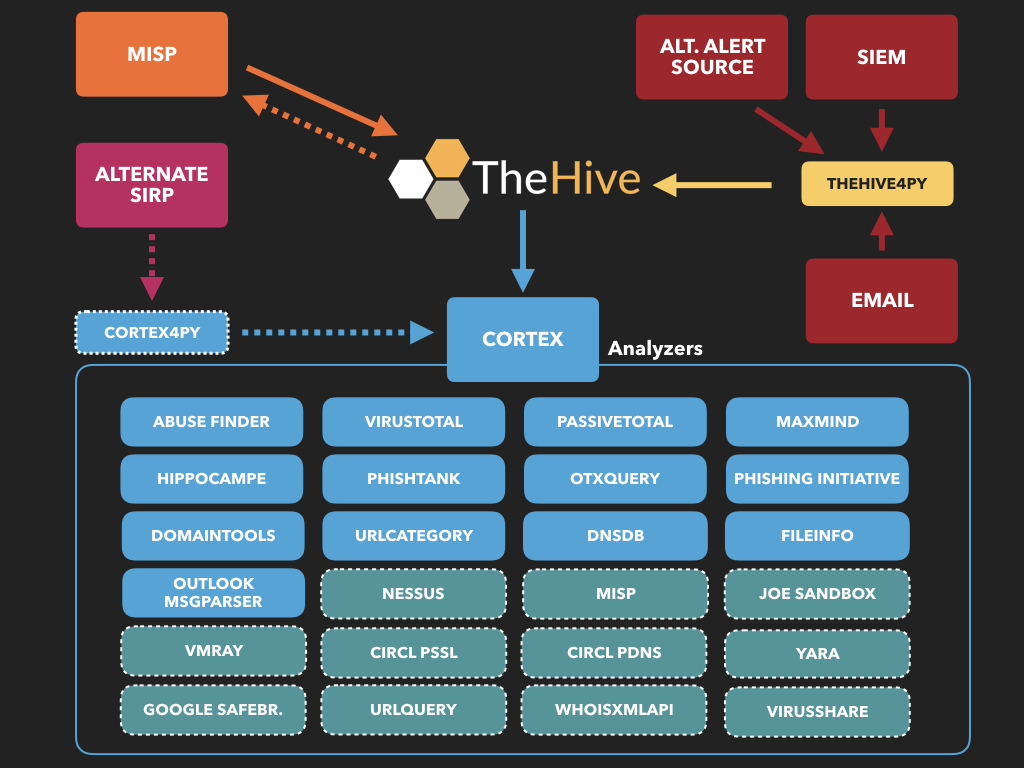
- An alert from the SIEM becomes a case in TheHive
- The analyst adds observables to the case: IPs, domains, hashes, URLs
- Cortex runs analyzers against each observable, including a lookup in MISP
- A hit tells the analyst this is already known intel, with the context attached
- A confirmed new indicator gets exported to MISP as an event
- That event is now available to every future lookup, and optionally shared onward
Cortex is the glue
The piece that makes the observable-to-intel lookup happen is Cortex, the analyzer engine that ships alongside TheHive. Cortex runs small modules called analyzers against an observable and returns a verdict. There is a MISP analyzer that queries your MISP instance, and dozens of others for the usual enrichment sources. Set it up once and an analyst just clicks run on an observable rather than pivoting to another tool. The reverse direction, pushing a confirmed indicator out, is handled by TheHive's MISP export so an analyst can turn a case observable into a shared event without leaving the case.
What is different inside a bank
A bank is not a lab, and a few constraints shape the whole design. Everything tends to stay on internal infrastructure rather than a cloud SaaS, so plan for self-hosting all three components and keeping the traffic between them inside a controlled segment. Data sensitivity matters when you share to MISP: use the distribution and tagging controls so an indicator tied to an internal investigation does not accidentally get shared to an external community. And access is not a detail, TheHive and MISP both hold sensitive material, so tie them into your identity provider and keep roles tight. The technology is the easy part, the governance around what may be shared and with whom is where the real work is.
Not a replacement for the analyst
These tools make a good analyst faster, they do not make decisions. An automated MISP hit is a strong hint, not a verdict, and blindly trusting every feed indicator is how you generate your own false positives. Keep a human in the loop on anything that triggers a real response.
Getting it running without regret
- Stand up MISP first and load it with feeds you trust before connecting anything
- Connect TheHive to Cortex, then Cortex to MISP, and test one observable end to end
- Agree tagging and distribution rules before analysts start exporting, not after
- Start with a small analyzer set and add more once the workflow is a habit
- Back up both databases, the intel you build over months is worth more than the install
TheHive answers where are we on this incident. MISP answers have we seen this before. Wire them together through Cortex and every case quietly makes the next one easier, which is the whole point of a SOC that learns instead of just reacting.
Thoughts?
Drop a comment below - it'll show up here once I read it.